
The way people research and evaluate companies, products and services is changing fast. According to Forrester, 89% of business-to-business buyers now rely on generative artificial intelligence (AI) as a primary source of information, while a 2024 Morning Consult survey found that nearly half of consumers are using it as well. And it’s easy to understand the appeal.
Why piece together scattered bits of information online when AI tools like ChatGPT and Gemini can scan the entire internet and return a clear, summed-up answer in seconds?
With more buyers turning to AI to cut through the noise, business leaders need to understand how this shift in search behavior differs from traditional search engine optimization (SEO) — and how effective generative engine optimization (GEO) will keep their brand visible as AI increasingly influences and redefines buyer perception.
But First, What Is GEO?
Unlike traditional search, AI tools like ChatGPT, Gemini and Google AI Overviews don’t display a list of links. Instead, they scan the web, pull from various sources and blend that information into a single, summarized response — a process called “synthesis.”
GEO is the practice of optimizing content to improve a business’s chances of showing up those AI-generated answers. Unlike SEO, which focuses on securing high rankings on the search engine results page, GEO is about making information clear, credible and relevant enough for AI to choose it as the answer. What’s the difference between SEO and GEO?
| SEO | GEO | |
|---|---|---|
| Main Goal | Rank higher on Google search results | Be included in AI-generated answers |
| How Buyers Find You | Found through clickable links in search results | Mentioned directly in the AI’s summarized response |
| What It Optimizes | Website content, specific keywords people search for and signals that show your business is credible like positive reviews, reputable backlinks and consistent online presence | Website content and credibility signals, but with a stronger focus on how information is presented, using Q&As, long-tail questions and how-to guides AI can pull from |
| What It Influences | Drives traffic directly from the results page to your site | Shapes how (and how often) AI presents your brand |
| Why It Matters | Helps buyers discover your business | Helps buyers trust and choose your business |
Other AI Visibility Terms Are Still Taking Shape
Because GEO is relatively new, the terminology around it is still evolving. Multiple overlapping phrases have gained traction as people work to understand the growing influence of AI-powered search and the strategies needed to show up within it, such as:
- Answer Engine Optimization (AEO): Aims to secure short, AI-assisted placements in Google’s featured snippets and voice tools like Alexa or Siri.
- Generative Search Optimization (GSO): Very close to GEO but sometimes used to mean a wider approach for visibility in any AI-driven search tool, whether it’s chat-based or built into search engines.
- LLM (Large Language Model) Optimization: Focuses on structuring information so AI tools, like ChatGPT, can clearly understand it and share it back to people accurately.
For now, these differences are subtle and sometimes hard to untangle, but they’re likely to become clearer (and more important) as AI-powered search advances.
What Business Leaders Need to Know About GEO
Labels aside, the reality is the same: How buyers search has shifted, and AI is changing what they see. Companies must now consider how to appear in ChatGPT search summaries and other AI tools.
The Top of Google’s Page 1 Has a New Gatekeeper
Getting to the top of Google hasn’t stopped being important, but what “the top” looks like has changed. The once-coveted No. 1 organic link or featured snippet has been replaced by Google’s AI Overviews in most cases. 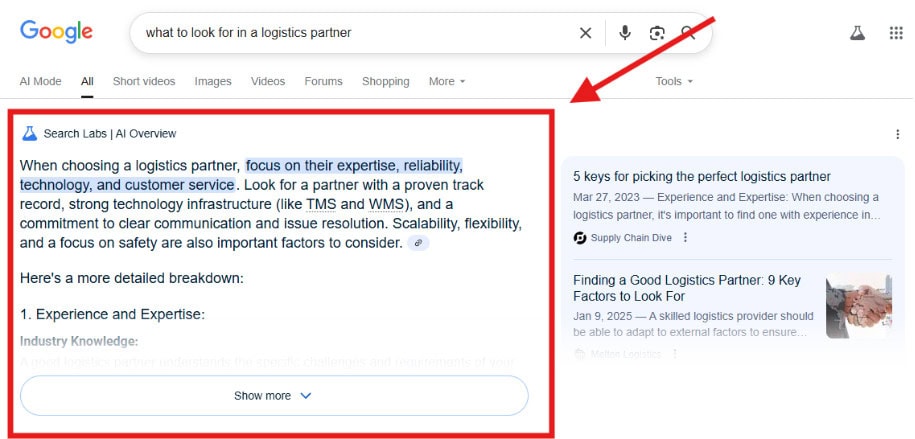 According to a 2025 Pew Research Center study, 58% of U.S. users saw one of these summaries in their searches, and when they did, most didn’t click anything below it.
That shift is significant. When decision-makers use Google to explore solutions, compare partners or vet vendors, they’re likely getting the information they need from the summary alone. If a business isn’t showing up there, it could be out of the conversation.
A dip in website traffic is common, and even expected, when Google AI Overviews take center stage. While strong GEO can improve your chances of appearing in those summaries, that alone won’t recover lost clicks.
Because many viewers are simply seeking information, the real opportunity lies in creating content for every phase of the customer journey — a strategy that strengthens both GEO and SEO reach.
But GEO Doesn’t Work Without Good SEO
While GEO is growing in importance, SEO still matters. AI tools rely on the same quality and credibility signals search engines have valued for years. That includes clear site structure and information that reflects real expertise, experience, authority and trustworthiness (known as the E-E-A-T framework).
Originally coined by Google, E-E-A-T isn’t a measurable score or part of any algorithm, it’s a framework for building user trust. And because trust drives visibility everywhere, applying these principles supports both SEO and GEO performance.
High-quality content that answers real questions, builds trust and resonates with both people and algorithms matters more than ever. Companies with strong SEO foundations have sites AI tools can interpret as credible sources, and that credibility paves the way for stronger GEO visibility.
AI Has a Favorite (And It’s Earned Media)
A 2025 Muck Rack study analyzing millions of AI-cited links across hundreds of thousands of prompts found that more than 95% of sources in AI-generated answers came from unpaid content. Of those, 85% were earned media.
Earned media, such as press releases, trade publication mentions and guest-contributed articles all influence how AI perceives a brand. In some cases, a company’s own news release may be cited if it links to trusted coverage.
For business leaders, this means a solid public relations strategy (and frequently updating your website’s newsroom with fresh content) can no longer sit on the sidelines. Strategic media coverage now directly influences visibility, buyer perception and how often a brand appears in front of decision-makers using AI to evaluate their options.
Attract Potential Buyers with Content That Earns AI Visibility
GEO, AEO, GSO — call it what you want. At the core, your buyers just need to find you, trust you and act in a new era of search. That requires content built for evolving AI systems and the discerning decision-makers who leverage them.
Explore our content marketing services to see how we can help keep your brand visible — wherever and however your buyers search.